A proper Lowcountry boil needs more than a recipe. You need the right amount of shrimp, sausage, corn, and potatoes per guest, a newspaper-lined table, and something cold to drink. This guide gives you a real, tested recipe for 8 to 10 people, plus the hosting details most sites skip entirely.
A Lowcountry boil is not just dinner. It’s a whole event, and around here, we take it seriously. Around the Holy City, a proper boil means a big pot, an even bigger appetite, and a table you’re not afraid to get messy. If you’ve only ever seen this dish on a recipe card, you’re missing half the story. The other half is what happens before the shrimp even hits the water: how much to buy, where people sit, what they drink, and how you clean it all up in twenty minutes flat.
We wrote this guide because most articles pick a lane. Either you get a bare ingredient list with no context, or a cute essay about Southern hospitality with no actual recipe to cook from. We wanted both. Below you’ll find the real history, the real math on how much shrimp and sausage to buy per guest, the table setup that makes cleanup painless, drink pairings that actually work, and a complete recipe that feeds 8 to 10 people. Consider this your one-stop plan for how to host a Lowcountry boil that feels like it came from someone’s grandmother, not a website. For more backyard party ideas, browse our outdoor entertaining guides.
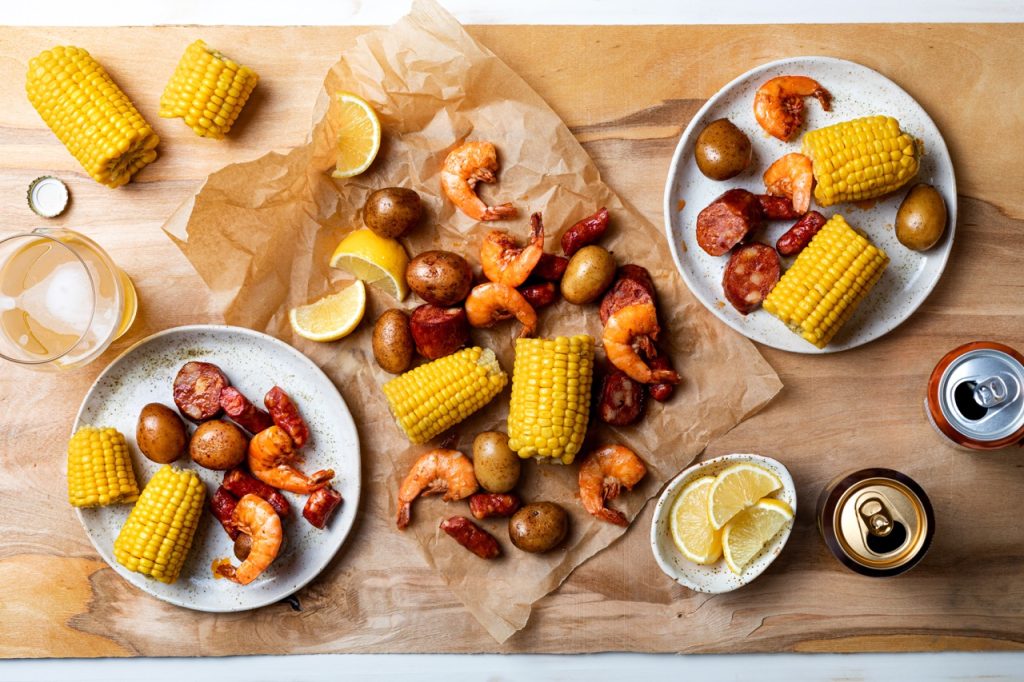
What a Lowcountry Boil Actually Is
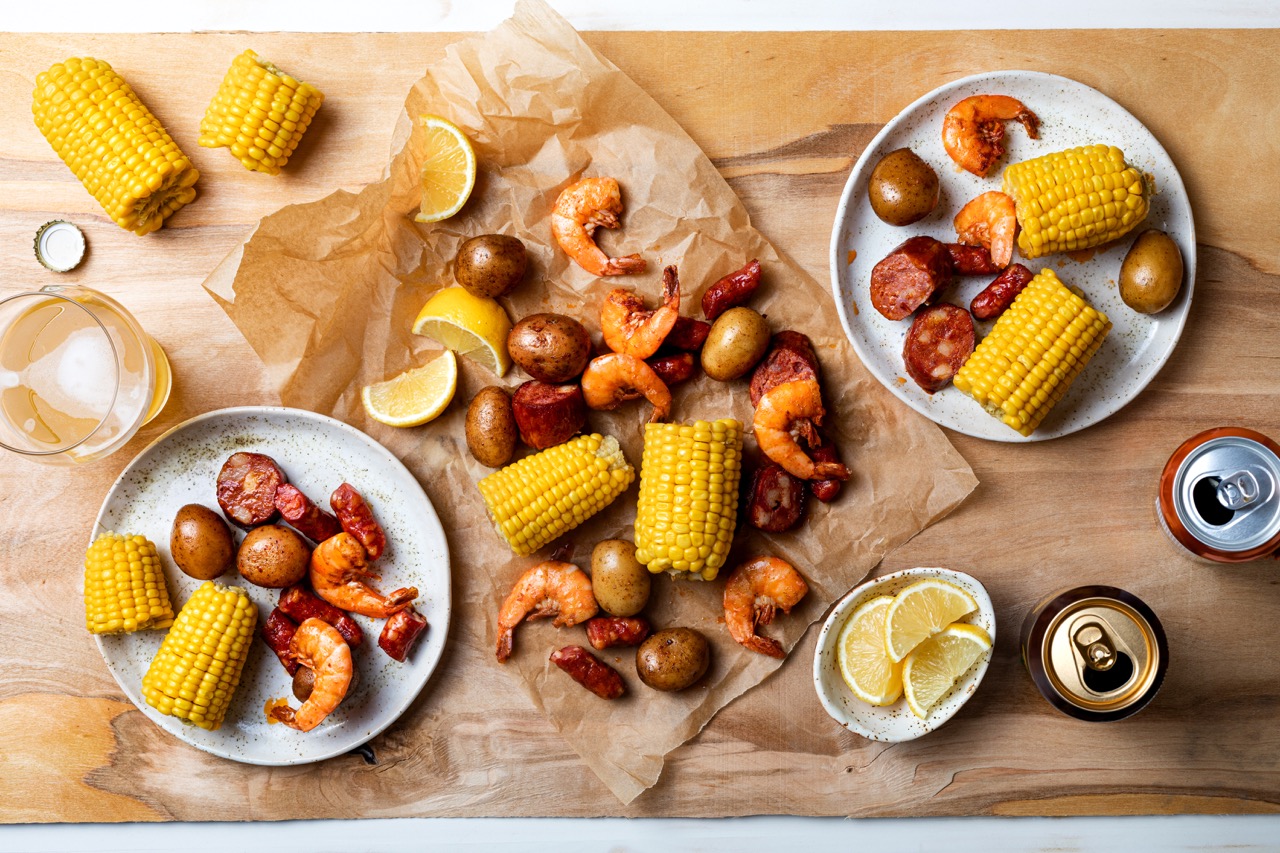
Let’s start with names, because people get confused here. Lowcountry boil, Frogmore stew, and Beaufort stew all describe the same basic dish: shrimp, smoked sausage, corn, and potatoes, boiled together in seasoned water and served in one big, glorious pile. The dish gets its most famous name from Frogmore, a small fishing community on St. Helena Island near Beaufort, South Carolina. Local legend credits the specific name “Frogmore stew” to Richard Gay, a shrimper and National Guard veteran who threw the dish together in the 1960s using whatever he had on hand, according to Garden & Gun.
But the dish itself is much older than that name. Its roots trace back to the cooking traditions of the Gullah Geechee people, descendants of enslaved West Africans who worked the rice and cotton plantations along the Sea Islands of South Carolina and Georgia. They built communal, one-pot cooking into daily life long before anyone wrote a recipe down, as both Discover South Carolina and Beaufort.com note in their histories of the dish. Shrimp came straight from the marsh. Sausage was often made from meat trimmings plantation owners didn’t want. Nothing about this dish was ever fancy. That’s the point.
So when you host a Lowcountry boil today, you’re not just cooking dinner. You’re borrowing from a long tradition of feeding a crowd well with humble ingredients and zero pretense. Keep that spirit in mind, and the rest of this guide will make a lot more sense.
How Much to Buy: Lowcountry Boil Quantities Per Person
Here’s where most recipe sites leave you stranded. They’ll tell you how to cook the shrimp, but not how many pounds to buy for twelve people. We did the math so you don’t have to guess and end up with a table full of hungry guests and an empty pot.
As a general rule, plan on the following per guest:
- Shrimp: about ½ pound per person, shell-on
- Smoked sausage: about ¼ pound per person
- Corn: half an ear to a full ear per person, depending on how much your crowd loves corn
- Small red or new potatoes: about 3 small potatoes, or roughly ⅓ pound, per person
These ratios line up with the guidance found in detailed breakdowns of Frogmore stew proportions from The Seasoned Mom. For a party of 8 to 10, that works out to roughly 4 pounds of shrimp, 2 pounds of sausage, 8 ears of corn, and 3 pounds of small potatoes. That’s exactly what our recipe below is built around.
A word of advice: buy a little more shrimp than the math says you need. Shrimp is the star of the show, and nobody wants to watch it run out first. Sausage and potatoes are cheap insurance if you’re worried about big eaters. Round up on those before you round up on anything else.
Setting the Table the Right Way
This is the step almost every recipe article skips, and it’s the one that makes a Lowcountry boil feel like a Lowcountry boil instead of a fancy dinner party. You don’t need plates. You barely need a table setting at all.
The tradition is simple: cover a long table in butcher paper or several layers of newspaper, then dump the drained boil right on top. Guests dig in with their hands. As Tasting Table explains, newspaper became the go-to table cover partly because most households already had a subscription, and partly because it’s cheap, absorbent, and easy to toss when dinner is done. Butcher paper works just as well if you’d rather skip the newsprint smudges on your forearms.
A few practical notes for your own table. Use at least two or three layers of paper so grease and broth don’t soak through to the table underneath. Set out rolls of paper towels within arm’s reach instead of folded napkins, because folded napkins do not stand a chance against a peel-and-eat shrimp situation. If you want to feel extra prepared, put a small bucket or bowl at each end of the table for shells. It’s optional, but your compost bin will thank you. Pair the table with our favorite casual outdoor tablescape ideas if you want a little more polish without losing the mess-friendly setup.
Skip the fine china entirely. Part of what makes this meal feel like Charleston is the fact that nobody is worried about their outfit or their table manners. Roll up your sleeves and go.
What to Drink at a Lowcountry Boil
The food is bold and a little spicy, so the drinks should be simple and cold. Cold domestic beer is the classic pairing, and a crisp pilsner or lager cuts through the Old Bay better than almost anything else. If you want to support a local brewery, this is the moment for it. We’ve rounded up a few Charleston-area breweries worth a growler run if you need suggestions.
For the non-drinkers and the kids at the table, sweet tea is the obvious answer, and it never feels out of place next to a pile of shrimp. Lemonade works too, especially in the thick of a Charleston summer when the humidity makes everyone thirsty by five o’clock. If your crowd likes wine, keep it light and crisp. A dry rosé or a cold sauvignon blanc won’t fight with the seasoning the way a big red would.
Whatever you pour, keep it in coolers full of ice rather than a fridge people have to keep walking back inside for. Half the charm of a Lowcountry boil is that everyone stays outside, barefoot and plate-free, until the pot is empty.
The Recipe: A Real Lowcountry Boil for 8 to 10 People
This is the part that actually gets you dinner. Below is a full, scaled recipe built around the quantities above, with cook times pulled from traditional preparation methods and confirmed against multiple tested sources.
Ingredients (serves 8-10)
- 6 quarts (1½ gallons) water
- ¾ cup Old Bay seasoning, plus more to taste
- 2 lemons, halved
- 1 large yellow onion, quartered
- 6 garlic cloves, smashed
- 2 bay leaves
- 3 lbs small red or new potatoes
- 2 lbs smoked sausage (andouille or kielbasa), cut into 2-inch pieces
- 8 ears fresh corn, husked and halved
- 4 lbs large shrimp (16-20 count), shell-on
- Optional: 1-2 lbs snow crab clusters or blue crab
- For serving: extra lemon wedges and cocktail sauce
Instructions
- Fill a large stockpot (at least 12 quarts) with the water. Add the Old Bay, lemons, onion, garlic, and bay leaves. Bring to a rolling boil over high heat.
- Add the potatoes. Boil for 12 to 15 minutes, until they’re almost fork-tender but not falling apart.
- Add the smoked sausage, and the crab if you’re using it. Boil for 5 minutes.
- Add the corn. Boil for 5 to 7 minutes more, until the corn is bright and tender.
- Add the shrimp. Boil for 2 to 3 minutes, just until the shrimp turn pink and opaque. Don’t walk away. Shrimp overcook fast.
- Turn off the heat immediately. Let everything sit in the hot liquid for 2 to 3 minutes to soak up extra flavor.
- Drain the pot well using a large colander or the basket insert if your pot has one.
- Dump the drained boil directly onto your newspaper- or butcher-paper-lined table. Sprinkle with a little extra Old Bay and serve with lemon wedges and cocktail sauce on the side.
Prep time: 20 minutes · Cook time: about 30 minutes · Total time: about 50 minutes
Cleanup, Charleston-Style
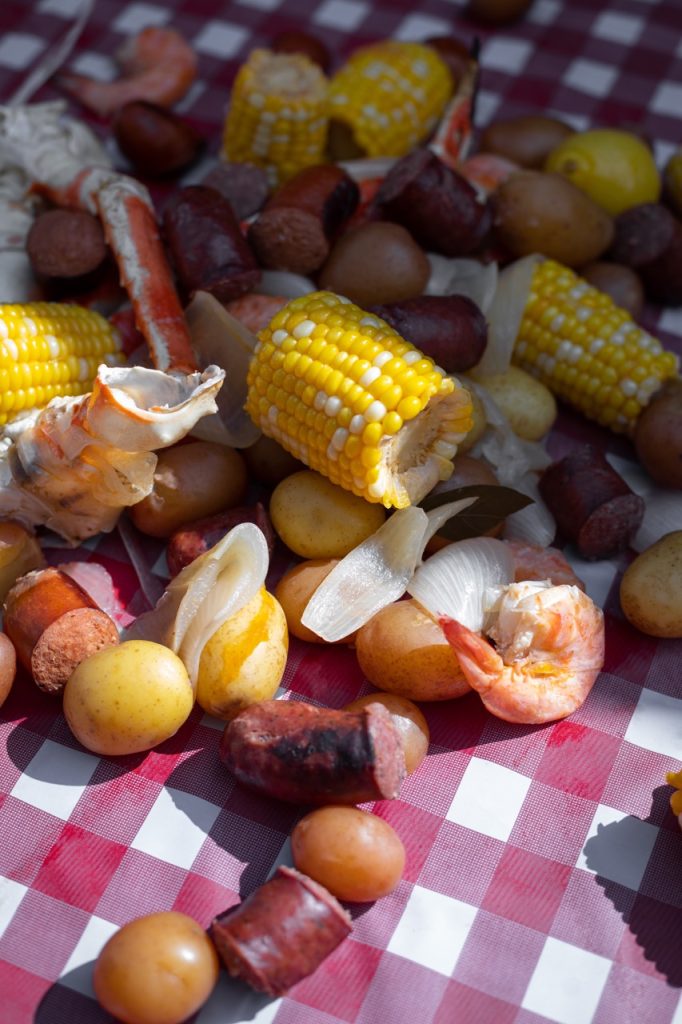
Here’s the part nobody tells you about, and it’s honestly one of the best reasons to host a Lowcountry boil instead of almost anything else. When the meal is over, you gather up the corners of the newspaper or butcher paper, fold the whole mess into a bundle, and carry it straight to the trash. There’s no stack of dishes waiting in the sink. There’s no scrubbing shrimp shells off a tablecloth at eleven at night.
Keep a big trash bag open and ready near the table before anyone sits down. Have a hose or a bucket of soapy water nearby for hands, since wet wipes only go so far against Old Bay. If you used a bucket for shells during dinner, that’s one less thing to scrape off the paper later. Wipe down the table itself with a damp cloth, and you’re done. Most hosts we know finish cleanup before the last guest has even pulled out of the driveway.
That ease is part of why this dish has stuck around for generations. It’s a feast built for people who want to spend the evening talking, not scrubbing pots. If you’re building out a full party menu, check out our easy Southern side dishes for a crowd to round things out.
Ready to Host Your Own
A Lowcountry boil rewards hosts who plan the whole evening, not just the pot. Buy enough shrimp, cover the table right, keep the drinks cold, and let people eat with their hands. That’s really all it takes to pull off a party that feels like it’s been happening on this coast for a hundred years, because in some form, it has. If you’re new to Charleston or just new to hosting, start with this guide, invite more people than you think you can feed, and let the newspaper do the rest of the work. Browse our Events pillar for more Charleston-approved party plans, and let us know how your boil turns out.